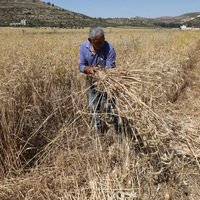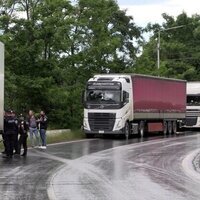


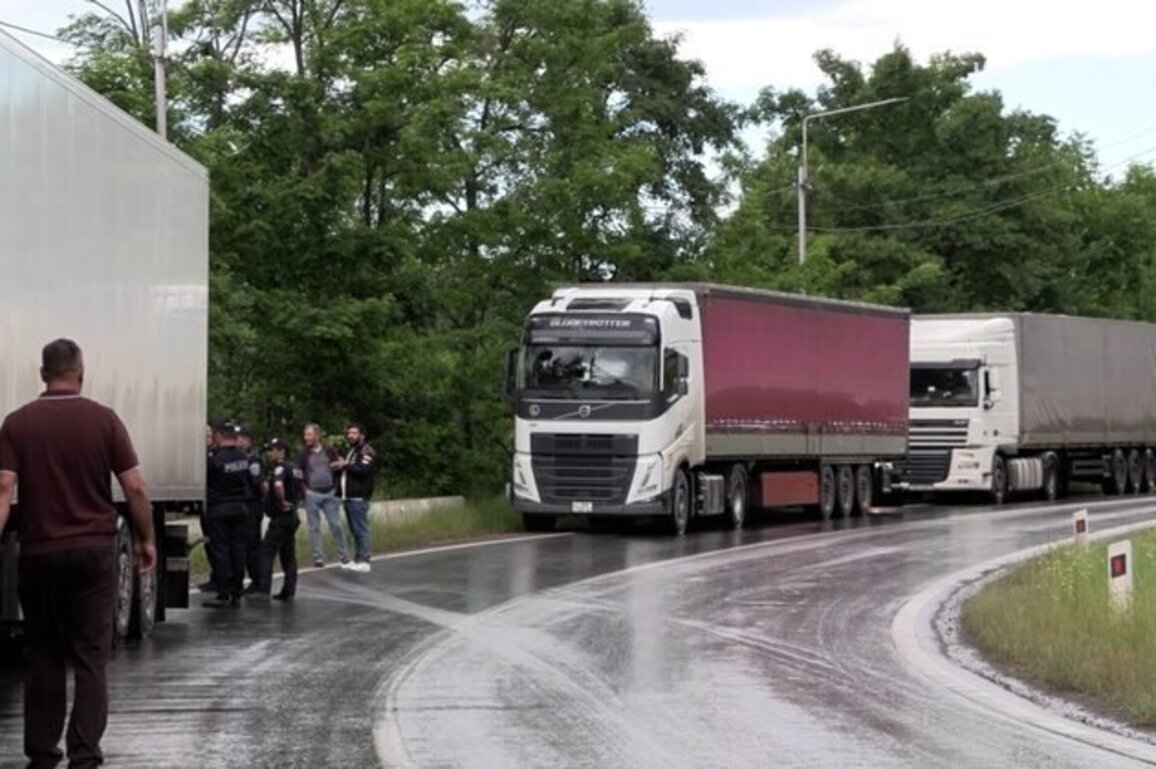
BAGRATASHEN, ARMENIA -- In a lush green valley in northern Armenia, near the border with Georgia, trucks were lined up on tarmac still glistening from a recent shower. The stationary vehicles bore witness to a geopolitical battle in which Russia is trying to prevent Armenia seeking closer ties with the West.
In interviews withRFE/RL's Armenian Service, the drivers shared stories of heading to Russia laden with exports only to be turned back.
"They reviewed all our documents and saw the quality of our strawberries, the produce grown by our villagers. But it was simply a political decision," said Narek Yeghinian, explaining the fate of his 20-ton cargo was unclear.
Another driver, Ara Isoyan, had brought back the same quantity of peppers.
"They claimed to have found a disease in our peppers that only affects tomatoes. They sent us to a parking place where we had to pay all the related costs. We were turned back after spending a day there," he said.
Ara Isoyan was one of many truck drivers who say they were turned away at the Russian border.
The truckers are concerned about Russia's increasing restrictions. On June 2, Russia's agricultural watchdog, Rosselkhoznadzor, announced measures affecting Armenian potatoes, eggplants, dried fruits, and stone fruits.
This followed earlier moves against other types of vegetables, fish products, and mineral water.
Official statements have spoken of health and safety concerns, but the Kremlin has made its real motives absolutely clear.
Armenians go to the polls on June 7 in parliamentary elections in which the country's basic foreign policy orientation is at stake. While Prime Minister Nikol Pashinian has pulled the country toward theUnited Statesand theEuropean Union, Russia has responded with multiple moves aimed at halting the Westward shift.
This has included threatening to expel Armenia from theMoscow-led Eurasian Economic Union (EAEU), warning it may cut off preferential fuel supplies, and making numerous statements to ratchet up the pressure on Yerevan.
Speaking at a summit in Astana, Kazakhstan, on May 29, Russian PresidentVladimir Putineven made a dark hint that Armenia should be wary of Ukraine's fate.
"The crisis in Ukraine began with efforts to move toward EU accession," he said, adding that Armenia would lose its markets in Russia and other EAEU countries, lose cheap energy imports, and face barriers for its migrant workers going to Russia -- whose remittances have been economically important for decades.
"These changes could result in a loss of at least 14 percent of Armenia's GDP," Putin added.
EU To The Rescue?
Pashinian has made it clear he's serious about realigning Armenia.
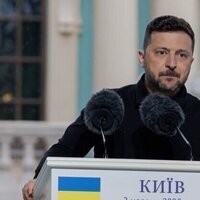
In May, he rolled out the red carpet to welcome EU and other European leaders at a summit in Yerevan, including Ukrainian President Volodymyr Zelenskyy.
Pashinian has also frozen Armenia's membership in a Russia-led security pact, the Collective Security Treaty Organization (CSTO).
Last year, the country passed a law initiating the process of EU accession. Although it is a goal that would take many years to achieve, Brussels has pushed hard to encourage Yerevan's pro-EU agenda and is also seeking to provide practical support.
SEE ALSO:
Armenia Wants In On Asia-Europe Trade. Russian Rail Control Stands In The Way.
This was emphasized on June 4, three days before polling day, in a phone call between Pashinian and EU chief Ursula von der Leyen.
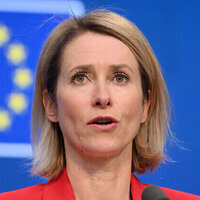
"Today I spoke with Prime Minister Nikol Pashinian about Russia's recent restrictions targeting Armenia. This is nothing short of economic coercion, and it is unacceptable," she said in a statement after the call. "Moscow is weaponizing economic relations for political pressure."
A plan is in the works for what the EU calls Autonomous Trade Measures (ATMs) that will enable preferential trade treatment for Armenian agricultural products.
But in the line of truck drivers at Bagratashen, there was skepticism about the EU.
"Will Spain allow us to sell tomatoes in Europe? Will Bulgaria let us sell peppers? Or will France allow us to sell brandy?" asked one driver, who declined to be named.
There is, as yet, no clear answer to these questions -- although sources in Brussels suggested the ATMs would relate to seasonal goods. Importantly, there's also no detail on the volumes involved.
Another issue is simply getting goods to market. The EU statement speaks of newly opened routes through Turkey and also transporting produce through Georgia, but these are time-consuming, expensive journeys.
In any case, there's quite a hill to climb. A look at official statistics from recent years shows that trade with Russia has been rising steadily and strongly outpacing that with the EU.
Graphic: Armenian Trade With Russia Outpaces That With EU
'A Geopolitical Marketplace'
Of course, Armenia does have other trading partners. The United Arab Emirates, for example, is its biggest export market, according to theObservatory of Economic Complexity, purchasing mostly gold, jewelry, and diamonds.
In an analysis on June 3, Caucasus expertThomas de Waal, a senior fellow with Carnegie Europe, said the whole region was seeking to diversify in a new, multipolar reality.
"The idea that the region is bipolar, caught in a binary clash between Russia and the West, does not apply today -- apart from in the minds of Kremlin strategists. Instead, the South Caucasus is a geopolitical marketplace," de Waal wrote.
"The European Union, China, the Gulf States, India, Turkey, and the United States are all present here. In this crowded field, Russia is now one among many," he added.
SEE ALSO:
Bypassing The Kremlin: Armenia And Azerbaijan Expand Trade, Testing Russia's Grip
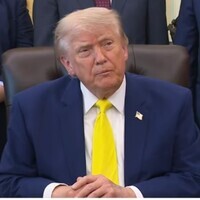
The United States is a case in point. US President Donald Trump hosted Pashinian and Azerbaijani President Ilham Aliyev at the White House last year to symbolically bring an end to decades of conflict, both hot and cold.
A key part of the deal is a trade corridor running across Armenian territory, linking Azerbaijan to itsNakhchivanexclave while opening a new east-west trade artery bypassing Russia and Iran.
The route is dubbed the Trump Route for International Peace and Prosperity (TRIPP,) and the US president has given his personal backing to Pashinian. "Nikol has my complete and total endorsement for reelection," wrote Trump on social media on May 27.
Map: Proposed Trump Route For International Peace And Prosperity (TRIPP)
US Secretary of State, Marco Rubio, who was speaking at Congressional hearings this week, noted that Russia appeared to be riled.
"The Russians are less than happy about our engagement there. I think there's evidence that they would like the current [prime minister] to lose his election as a result of this growing relationship with the United States," he told the Senate Foreign Relations Committee on June 2.
But, he added, "we're not asking them (Armenia) not to be friends with other countries."
Happy Birthday From Putin
In Armenia itself, these debates have continued to play out as the election draws near.
"We are used as a platform against Russia," Samvel Karapetian, head of the leading opposition party, Strong Armenia, told reporters on May 27. "Every day we could scream about the best relationship with the EU but not be able in any way to capitalize on that relationship."
Karapetian was arrestedlast year on charges of calling for the unlawful seizure of power. At the time, Richard Giragosian, head of the Regional Studies Center think tank in Yerevan, told RFE/RL the arrest was "a move by the Armenian government to preempt any Russian interference" in the elections.
Karapetian, a billionaire with dual Russian-Armenian citizenship, is currently under house arrest in Yerevan. He says the charges against him are politically motivated.
For his part, Pashinian has said he is not seeking a rupture with Moscow.
"I have truly friendly relations with the president of the Russian Federation," he said at one campaign rally in May.
More recently, he said Putin had phoned him to wish him a happy birthday on June 1, and an official statement praised Putin for his "friendly tone."
Russia Uses Economic Chokehold To Counter Armenia's Westward Tilt
ShareCopy link
Facebook
X (Twitter)
LinkedIn
Email
Share
ShareCopy link
Facebook
X (Twitter)
LinkedIn
Email
Share
Follow usFacebook
X (Twitter)
Youtube
Instagram
Follow us